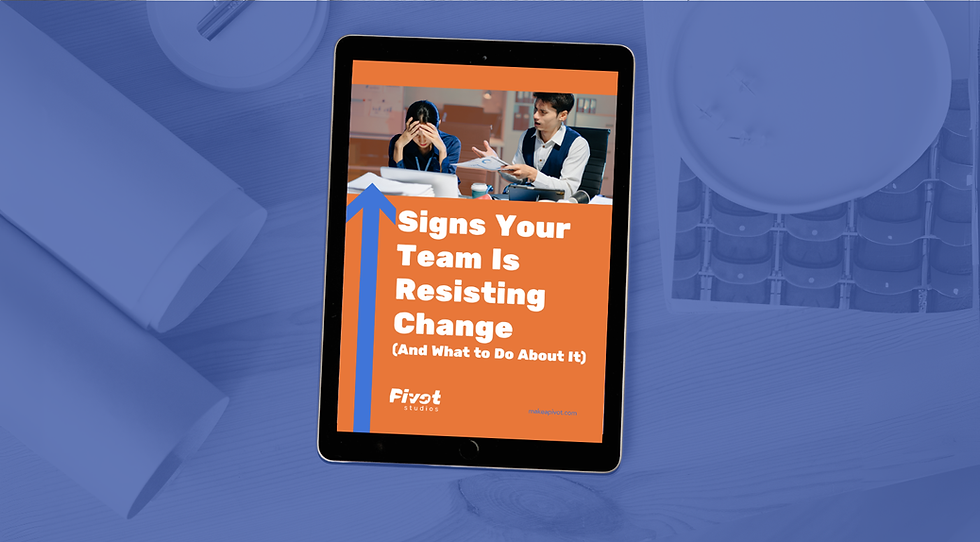
Signs Your Team Is Resisting Change (And What to Do About It)
How to Recognize Resistance Early—Before It Slows Everything Down
Most leaders think resistance to change looks like pushback.
It doesn’t.
It usually looks like:
Silence
Slow adoption
Workarounds
“We’ll get to it”
Simple truth:Team resistance to change is any behavior that prevents new processes, tools, or strategies from being fully adopted.
And if you don’t address it early, it quietly derails progress.
Why Do Employees Resist Change?
Before you fix resistance, you need to understand it.
Most resistance is not about attitude—it’s about uncertainty.
1. Lack of Clarity
If people don’t understand:
What’s changing
Why it matters
What’s expected of them
They hesitate or default to old habits.
2. Fear of the Unknown
Change often creates concerns like:
“Will I still be good at my job?”
“Is my role changing?”
“What if I fail?”
Even if unspoken, these fears impact behavior.
3. Increased Workload
If change feels like “more work” instead of “better work,”people will resist it.
4. Lack of Trust
If leadership hasn’t built trust, teams may question:
The purpose of the change
Whether it will actually help
Whether it will stick
5. No Reinforcement
If change is introduced once and never mentioned again,people assume it’s not a real priority.
7 Signs Your Team Is Resisting Change
Resistance is often subtle. Here’s what to look for.
1. Silence in Meetings
No questions. No feedback.
This usually means:
People are unsure
Or disengaged
2. Low Adoption of New Tools or Processes
You introduced something new—but people aren’t using it consistently.
3. Workarounds and “Shadow Processes”
Teams continue doing things the old way behind the scenes.
4. Missed Deadlines or Delays
Change slows execution when it’s not clearly understood.
5. Repeated Questions About Basics
If people keep asking the same questions, the message isn’t landing.
6. Managers Sending Mixed Signals
If managers aren’t aligned, teams won’t be either.
7. Minimal Improvement in Results
If nothing improves after change is introduced, adoption is likely low.
What Resistance to Change Actually Means
Resistance is not a sign of a bad team.
It’s a signal that something in the change process isn’t working.
Most often, it points to:
Lack of clarity
Poor communication
Misalignment
Overcomplication
Reframe (important): Resistance is feedback.
If you listen to it, you can fix the problem faster.
How to Overcome Resistance to Change
Here’s how to address resistance in a practical, effective way.
Step 1: Get Clear on the “Why”
Explain:
What problem you’re solving
Why this change matters now
How it benefits the team
Clarity reduces uncertainty.
Step 2: Make Expectations Explicit
Be specific about:
What needs to change
What people should do differently
What success looks like
Avoid vague direction.
Step 3: Simplify the Change
Ask:
Are we adding unnecessary complexity?
Can this be easier?
If the new way feels harder, people won’t adopt it.
Step 4: Equip Your Managers
Managers need to:
Reinforce the change
Answer questions
Model the behavior
Without them, adoption breaks down.
Step 5: Build in Reinforcement
Change requires repetition.
Use:
Check-ins
Progress tracking
Ongoing communication
Step 6: Address Concerns Directly
Create space for:
Questions
Feedback
Honest conversations
Ignoring concerns increases resistance.
What Not to Do When Facing Resistance
Avoid these common mistakes:
Forcing Compliance Without Clarity
This creates surface-level adoption—but no real change.
Assuming Silence Means Agreement
Silence often means confusion or disengagement.
Adding More Pressure Instead of Support
Pressure without clarity increases frustration—not results.
When Resistance Signals a Bigger Problem
If resistance is widespread, it may indicate:
Leadership misalignment
Poorly defined strategy
Lack of trust within the team
Too many changes happening at once
At this point, the issue isn’t just resistance.
It’s the overall approach to change.
The Bottom Line
Teams don’t resist change because they’re difficult.
They resist change because:
It’s unclear
It feels risky
It’s poorly implemented
When you fix those issues, resistance decreases—and adoption increases.
Need Help Getting Your Team On Board?
If your team is struggling to adopt new tools, processes, or ways of working, the issue isn’t motivation.
It’s how the change is being implemented.
👉 Explore change management consulting services


Comments